Average Reviews:

(More customer reviews)I have been using this trackball for about one and one half years and it has worked flawlessly for the entire period. Having had extensive, prolonged experience with this unit, I will try to convey my detailed impression, hoping it will be helpful to you all.
For people used to a mouse, trackballs take a bit of "getting used to", so please expect to feel a little clumsy at first, pointing to small targets. After a couple of weeks, most people should be as facile as working with a mouse at pointing, clicking and selecting. With a mouse you have a direct linkage to motion and position with what you see on the screen, while with a trackball your finger motions do not have the real spatial dimensions analagous to your arm movements with a mouse, so there is a learning curve to develop the necessary proprioceptive feedback in your fingers relative to what you see on the screen. Just be a little patient.On the plus side,your pointing device is happily stationary and you are not running off the desktop or your mouse mat, as well as not being so prone to repetitive stress injury using your index finger for all the clicking on the latter.
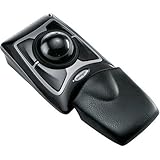
On this trackball there is the ball for cursor movement which you operate with your second and third fingers, plus 4 large, easily accessible, sensitive switches located centripetally around the ball which you access with your thumb, second, third and fifth fingers respectively, meaning that you spread the motions over the entirety of your hand. There is a scroll ring situated circumferentially at the base of the ball. Certain reviewers have stated that this ring is plasticky and cheap. Yes it is plastic, but it is NOT cheap, and it works like an energizer bunny, smoothly and reliably.It can be programmed in the software to scroll up or down, at different speeds, clockwise or counterclockwise.
The software is excellent and allows for custom programming of each of the buttons as well as simulataneous pressing of the top two and bottom two buttons(they call it chording), to virtually any of the standard click functions, as well as common menu commands in Windows, as well as Internet Browsers, all listed in drop down menus. That gives you six switch functions and a scroll wheel. You can also program any desired button to launch autoscroll. The somewhat complex software dialogue box is relatively intuitive, and can be navigated with a little thought and experimentation without even consulting the documentation, for those who are reasonably computer savvy, which is my main parameter for judging something to be user friendly.
I strongly recommend the use of the accessory wrist pedestal, provided in the package, to mitigate against the potential ergonomic pitfall of hyperextension of the wrist. The wrist support is padded and the overall unit then feels comfortable in the hand. Kensington has also provided a nifty option of a q20 minute reminder(if desired, set in the software dialogue) to signal a possible break, either by message or audio, to help avoid hand fatigue. I have not found it necessary, following the good habit of taking my hand off any pointing device periodically, just as a precaution.
I would like to point out that I use the equivalent WIRED version of this trackball 6-10 hours a day at the hospital PACS in radiology, and have suffered no repetitive use difficulties. In fact it was because of my positive experience with ubiquitous presence of this trackball at all our workstations that I switched from routine mouse usage. The requirements for pointing, drawing, selecting are more stringent at our imaging workstations than for most home computer applications, and after a couple of weeks getting used to the trackball I felt right at home.
I would like to address and confirm the complaint that the wireless version does EAT C cells. Obviously, the rate of comsumption depends on how extensively the unit is used. I would say with about 3-4 hours of use a day at home, the batteries last about a month, so figure on about $25/year in operating costs if you are buying batteries at standard prices. I would suggest that you buy the standard alkaline batteries, and not pay extra for Premium or Ultra higher cost cells which I have found by experimentation last absolutely NO longer. Buying the Premium batteries is like putting Premium gas in a late model car; waste of money, no matter what the manufacturer "recommends"!!! As for one reviewer's comment that the batteries are hard to replace, IMHO, anyone with a little digital dexterity and common sense can very easily figure out how to change them. There is an insert which blocks extraction of the batteries, probably to prevent incidental dislodging in case you turn the trackball back into usage position without the battery cover reinstalled. You merely insert you finger tip in between the two cells and lift the left one out first. You put the new ones in, just retracing your steps....just use a little logic with no problem once you figure out the trick. Kensington thoughtfully affixed an appropriate illustration onto the battery cover.
I spoke with Kensington about what seemed to be the inordinate battery consumption which they said is normal and is related to high power consumption by the complexity of the unit. I'm surprised that either an auto or manual on/off switch wasn't included, which would have been a trivial but useful feature to have added. The power consumption does drop dramatically in the standby mode, but the unit does not "sleep".
One point about the negative comments on the smoothness of the trackball: There is a slight coating on the new ball which they admit will cause it to seem a little sluggish at first. You can clean it off with alcohol(which is good idea periodically anyway) and reseat the ball. The trick is to then press the ball down firmly on the contacts and roll it around for a few seconds with that pressure, after which time the ball will glide effortlessly. Also be sure to take the ball out periodically and inspect the contacts which will accumulate dust, hairs etc. which will also impact on the ball's smoothness.
In sum, I find the $25/yr. battery costs only a very minor detraction from an otherwise very well designed, rugged, reliable, and versatile unit. My own Kensington wireless trackball works just as well as the day it came out of the box, approximately 18 months earlier, and I can say the same thing for the wired units at the hospital which see very heavy usage.
Although expensive, I highly recommend this unit for all general computer users, but please, for those who have not used a trackball before, be patient at the outset until you get used to a new way of pointing and clicking. For those users who are doing mainly graphics, stay with a tablet which is decidedly the peripheral of choice for those applications.
Pros:
1. Rugged, high quality, reliable design
2. Versatility in functional programming.
3. Easy access to free personalized tech support
Cons:
1. Expense
2. Battery consumption
Click Here to see more reviews about: Kensington Expert Mouse Wireless Optical Trackball for PC or Mac 64329


0 comments:
Post a Comment